

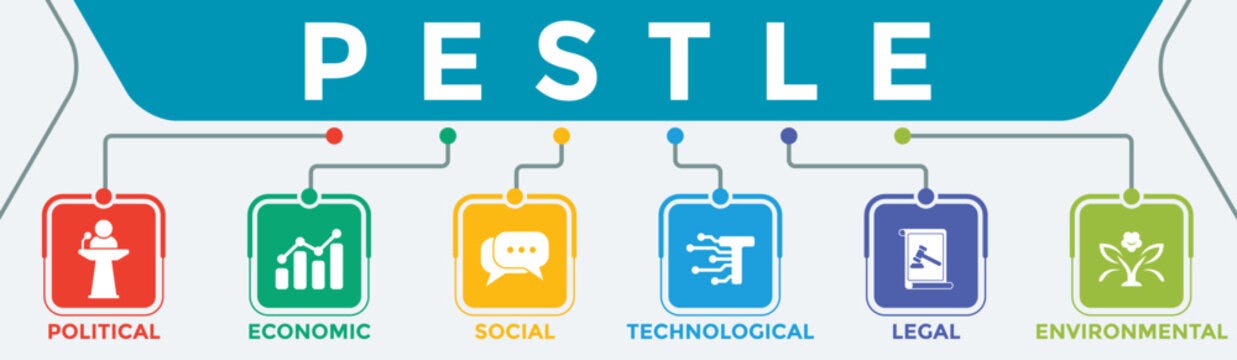
STRATEGIC PESTLE AUDIT — OMNIMART SOLUTIONS (OMS)
Institutional and Economic Foundations
1.1. Political Factors
Governance and Sovereignty: Political variables define the stability of the business environment. For a tech retailer, this involves both local and international policy.
Trade Policy and Protectionism: Sudden shifts in import duties on high-tech hardware like IoT sensors and servers or premium products can inflate operating expenses. OMS must monitor political movements toward economic nationalism, which might restrict the sourcing of global food brands.
Urban Infrastructure Subsidies: Political initiatives to construct smart cities or provide subsidies for renewable energy represent a significant tailwind. Government-backed solar incentives directly lower the cost of maintaining energy-intensive refrigeration chains.
1.2. Economic Factors: Market Volatility and Purchasing Power
The economic environment determines the velocity of growth and consumer spending capacity.
Inflationary Hedging and Down-Trading: In a high-inflation economy, consumers transition to cheaper alternatives. OMS uses its predictive analytics to identify these shifts early, procuring bulk inventory of value brands to maintain volume while competitors face stock-outs.
Foreign Exchange Exposure: Since much of the Smart-Stock technology is imported, currency devaluation is a primary concern. This increases the tech debt for maintenance and upgrades to the automated systems.
The Gig Economy Labor Market: The availability of a flexible, independent workforce for last-mile delivery enables OMS to scale its delivery app without the massive fixed overhead of a permanent vehicle fleet.
Human Condition and Technological Frontiers
2.1. Social Factors: The Time-Poverty Lens
This is the sharpest lens of the audit, comprehending the shifting values of the modern urban consumer.
The Chronos Deficit or Time Poverty: Modern urbanization has created a cultural crisis where professionals prioritize recovered time over price. The 20-minute delivery model is a direct remedy to this socio-cultural pain point.
Health-Consciousness and Green Status: There is a growing preference for organic and zero-waste purchasing. OMS aligns with this by offering bulk-refill stations, converting a social trend into a core brand strength.
Demographic Shifting: The rise of single-person urban households increases the demand for ready-to-eat meals and reduced portion sizes, requiring OMS to recalibrate its inventory away from traditional family-sized packaging.
2.2. Technological Factors: Innovation and Data Moats Technology is the primary enabler of the competitive advantage for OMS.
Reinforcement Learning in Inventory: The use of reinforcement learning allows for self-healing supply chains where the system autonomously adjusts orders based on real-time traffic, weather, and social media trends.
IoT and Smart Cold Chain: Real-time sensors in refrigerators prevent spoilage and ensure food safety, which is a significant differentiator in emerging markets with unstable traditional logistics.
5G and Edge Computing: High-speed connectivity allows for computer vision in-store, facilitating frictionless checkout without till queues and providing real-time theft detection.
The Regulatory and Ecological Frontier
3.1. Environmental Factors: Sustainability as a Mandate
Environmental factors are no longer externalities; they are now integral to operational continuity.
Climate-Related Supply Fragility: Extreme weather events like floods or droughts imperil the upstream supply of fresh produce. OMS uses geospatial intelligence to map and diversify its sourcing, ensuring empty shelves are avoided during local climate calamities.
The Circular Economy: New mandates to reduce single-use plastics are met by zero-waste stations. By eliminating packaging, OMS lowers its exposure to plastic taxes and appeals to the ethical consumer.
Energy Transition and EV Logistics: As cities implement low-emission zones, the transition to electric delivery bikes is a strategic necessity to avoid penalties and maintain access to high-density urban centers.
3.2. Legal Factors: Data, Labor, and Liability
The legal environment determines the freedom to operate and protects the brand from catastrophic litigation.
Data Privacy Compliance: As a data-first retailer, OMS must observe strict laws regarding consumer tracking like NDPR or GDPR. Privacy by Design is a legal requirement; failure to safeguard user data could lead to massive fines and a loss of brand trust.
Labor Reclassification: A significant legal concern is the potential reclassification of gig riders as full-time employees. This would mandate health insurance and benefits, increasing delivery costs by an estimated 30%.
Food Safety Liability and Traceability: Legal standards for food safety are rising. OMS utilizes a blockchain-ready ledger to provide an immutable audit trail of every product, mitigating the legal risk of food-borne illness outbreaks.
Strategic PESTLE Summary Table
| Category | Primary Driver | Strategic Response |
| Political | Data Sovereignty | Move processing to local Edge servers |
| Economic | FX Volatility | Increase sourcing from local agro-processors |
| Social | Time Poverty | Expand 24/7 automated pickup lockers |
| Technology | Predictive AI | Refine algorithms to reduce perishables waste |
| Environmental | Plastic Bans | Scale bulk-refill Zero-Waste stations |
| Legal | Data Privacy | Implement End-to-End encryption for loyalty data |